Who Profits?
On Tuesday the Minister for Police stood up in the other place and gave the House some numbers. The Other Place is how we in the Legislative Council refer to the Legislative Assembly. It is the place we do not like to refer to and perhaps one reason why is described in the next sentences. The Minist
On Tuesday the Minister for Police stood up in the other place and gave the House some numbers. The Other Place is how we in the Legislative Council refer to the Legislative Assembly. It is the place we do not like to refer to and perhaps one reason why is described in the next sentences. The Minister stated that since July, when cocaine was added to the roadside test, more than eight thousand drivers have been swabbed. Over a thousand came back positive and ninety-seven of those were for cocaine. He said it would keep our roads safer and made a small joke at the Speaker’s expense, and the House moved on.
Eight thousand swabs, a thousand and something positive, ninety-seven of them cocaine. Do the maths. Ninety-seven from a thousand and something leaves nine hundred and something, and those nine hundred were not cocaine. They were the three drugs the test already looked for: methamphetamine, MDMA and THC. No-one stated how many of the nine hundred positive tests were THC. Nor did anyone mention how many of the positive THC tests were for drivers who held a prescription from a doctor. Why? Because the State does not know. Why does the State not know? He did clearly name the offence, which was an example of my article from last week about “the word” that appears today carrying a fine for driving with a “prescribed illicit drug” in your oral fluid. By “prescribed” is meant the drug has been listed by regulation, on the Government’s say. Illicit means the word we chose in 1950. The price is up to twelve hundred and fifty dollars the first time, and the second time your licence for at least six months, all the while not one word ever states whether or not you could have walked a straight line. Impairment was named but never has to be proven.
Walker Briefing is a reader-supported publication. To receive new posts and support my work, consider becoming a free or paid subscriber.
Now notice how cocaine got onto that list. It was not by an Act of Parliament but by a regulation, signed in July. This is the same kind of instrument that has been used to alter the rules of this test four times since 2017. The list can be changed on an afternoon, without a vote. What cannot be changed on an afternoon is the offence itself, which sits in the Road Traffic Act and contains no defence at all, not for a prescription, not for a doctor’s letter, and not for the absence of any proof of impairment. Tasmania has had that exception since 2005. Victoria gave its magistrates the discretion to keep an unimpaired patient’s licence last year. New South Wales passed a law for it through both its Houses on Thursday. The only way to put it into Western Australian law is to change the Act, and nobody has brought that Bill. The Bill in my name changes a different Act; it changes the word itself. The advice on what to do about patients and this test has been sitting on a minister’s desk since after January, in a report the Government commissioned from its own experts, and I will come back to it. You can imagine how I felt when I saw that the list can be lengthened on whichever day the Government chooses, but the defence cannot be added until the House chooses, and the House has not been asked, because the Government has decided not to take its own report to cabinet for a decision.
Last week I gave you four questions to ask of any law. Who chose the word? What does the word carry that the evidence does not? Who does the word punish? And who would have to change it? I said I would put these four questions to the people who profit from keeping the word unchanged, so here they are, five of them, and then one more who is not on the list because he wrote it. I will start with my favourite beginning question: who is the beneficiary that nobody ever asks about?
The first is the trade. Cannabis is, by a wide margin, the most consumed currently prohibited plant-based substance in this country. The Crime Commission measures it in the sewage of millions of people every year. Nine out of ten cannabis arrests in Australia, on the last national count, are of the user, not the supplier. The word “illicit” defines a business that government has given to the criminal community, and they see this as the trade’s price list. That word allows them to set the premium, remove the receipt, and make the customer the criminal, leaving the supplier as the one in the chain the law hardly ever reaches in any numbers that matter. Ask the four questions. The criminal fraternity did not choose the word, but being given the business to run did not make them unhappy. The word carries a price the plant does not deserve. It punishes the buyer. And who would have to change it? Not the criminal fraternity, not at all! They will not be sitting in a committee room debating legislation. This is the cleanest profit of all: a business model written for the trade by the very law meant to close it.
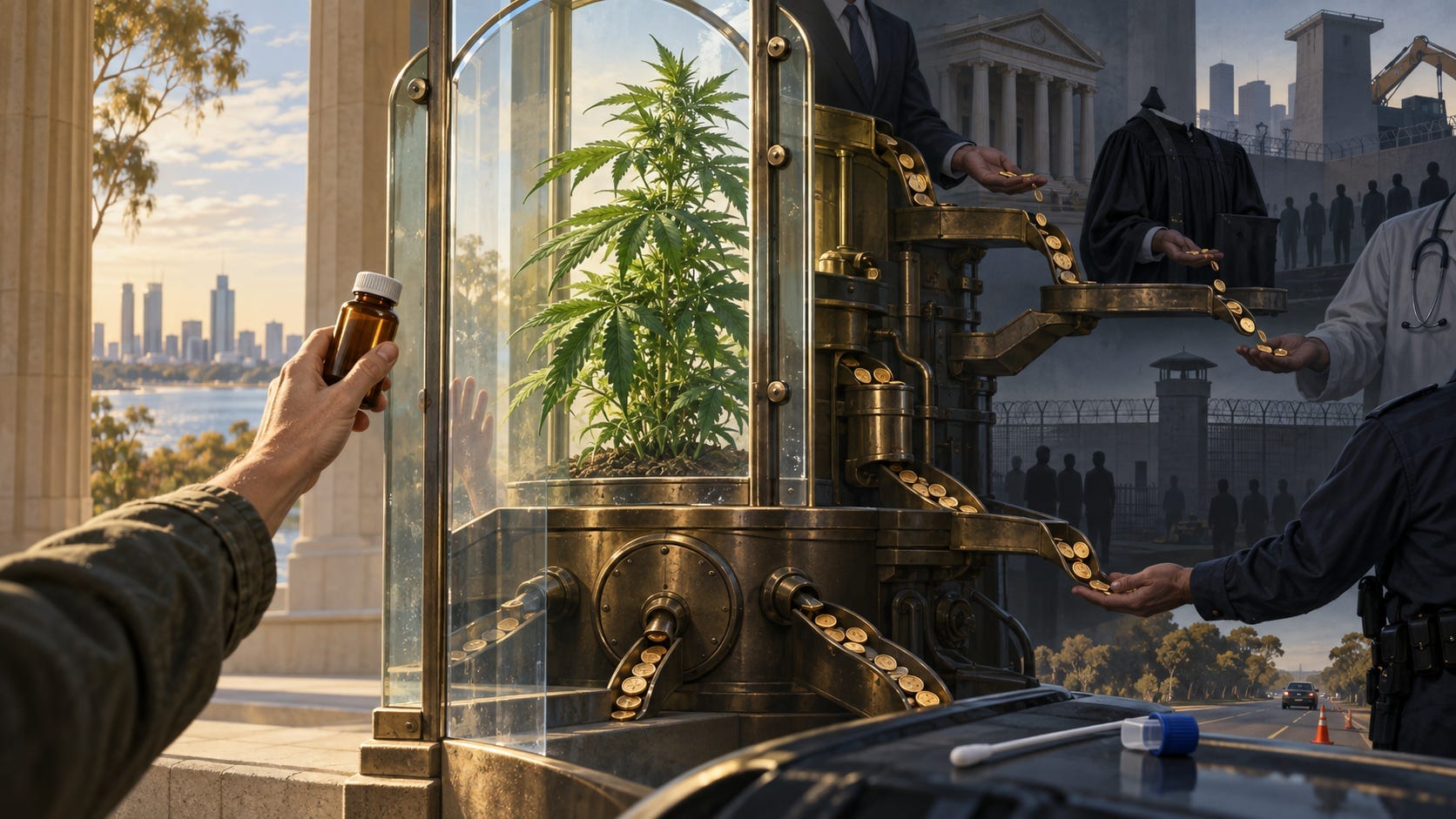
The second is the machine. Fifty-three thousand roadside swabs a year on a sixteen-million-dollar alcohol and drug testing line. Six and a half thousand charges for possessing cannabis in 2024, up from five thousand two years earlier. And on the driving side, every positive swab is a court matter, because the Police cannot issue an infringement for that offence even if they wanted to. But wait, there is more! The Police Force told me, in writing, in August, that it does not keep records of medicinal cannabis prescriptions, and that the drug-driving offence “can only be manually extracted” from its own system, so it cannot tell me how many of the drivers it has put before a court for THC were patients doing what their doctor told them. We have built a machine that puts thousands of people before a court every year over this plant, and for the drivers among them the machine cannot say how many were sick. This is not about hiding the number, it is worse than that. It is a number no-one could be bothered to document. Then there is the account. When property is confiscated from someone declared a drug trafficker, the money goes into a fund, and last year that fund took a record thirty million dollars. Out of it the prosecuting office receives a base allocation and then a variable sum on top, which the Auditor General in 2018 called a bonus payment, triggered when the money coming in beat a target, and which the Government told me in June has no target. Nobody prosecutes anyone for the money; I am not saying that and I do not believe it. I am saying that an account which pays on volume trains the institutions it pays, the way any incentive does, and that nobody can tell you what share of that thirty million came from cannabis, because that number is not published either. The four questions, then. The machine did not choose the word. The word carries the presumption that a positive swab is a dangerous driver, which the evidence does not carry. It punishes whoever it swabs. And it would be changed by the same Government that makes the regulations, on an afternoon, if it wished.
The third is the gate. The same plant, from the same field, is a Schedule 8 controlled medicine if you have a script and a Schedule 9 prohibited substance if you do not. I could go on to describe the gatekeepers in the same terms but on the other hand, they have no choice. That word “illicit” is not one they chose, and they have to abide by the rules set for them, so let me just state that they did not choose the word. That word “illicit” carries a queue. It punishes everyone on the wrong side of the script, and the word would have to be changed by the same house. The gate-keepers have no vote, but also no compelling reason to want one.
The fourth is not a person but a position, the comfort of not having to leave the position. When my Bill was put to the vote in 2024, the Government’s reason was that it had “made no change to its position”. The other side’s reason was that cannabis is “an entrance drug”, retold with a great deal of feeling and no evidence behind it. Both sides of the House voted the Bill down on the voices, without troubling to call a division. One year earlier the Minister told the House that changing these laws was “not a priority”. I believe that. It is not a priority. Because holding the word costs the holder nothing. Change it, and one crash on one wet night becomes the change’s fault in every headline in the State. Keep it, and six and a half thousand charges a year stay a statistic that carries nobody’s name. That is not villainy. It is the shape of a comfortable status quo, and whoever occupies that position feels the same comfort. The four questions here are easy. The position chose the word, or inherited it and kept the receipt. The word carries the position’s reputation for firmness. It punishes people who do not vote in that status quo place, and the status quo position of government is the only one on this list who could change it.
The fifth is, I regret to say, my own profession. Medicine is organised around the naming of a condition and the treatment of what the name implies. That is a good discipline when the name is earned, as I said last week. But there is a kind of unwellness that arrives in the consulting room with no name, only a story: a job that ended, a marriage that curdled, a childhood that should not have happened, a body that hurts for reasons no scan will show. What the patient is doing about it, very often, is medicating. And the word “illicit” is the gift the system gives itself here, because as long as the plant is the crime, nobody has to ask what the plant was for. We spend about two per cent of the country’s health budget on stopping people getting sick, and most of the rest on treating what they have already got. The word keeps the frame. As long as we have a drug problem we do not have to have a wellness problem, and a wellness problem would require us to look upstream at the things that no prescription reaches.
And then, I am afraid, there is me. In June 2024, when she rose to tell the House why the Government would not support my Bill, the Leader of the House acknowledged that I was bringing it because it is “directly linked to the reason for” my election. She was right, and it is not a comfortable thing to have said about you in Hansard. My seat exists because the word exists. So does the Bill. So, if we are honest, does the newsletter you may have been reading. Ask the four questions of me, then. I did not choose the word, but I have made a living off the fight against it. It carries, for me, a reason to be listened to. It punishes people I have sat across from, and I have not yet been the one punished. And who would have to change it? If I could I would, and on the day the House does I will have to find something else to write about on a Monday. I would not mind. There is no shortage: the cost of living, the price of fuel, the state of our environment, the tolling of the bell for war, hulls built from hemp, cleaner air, better schools, or ... well, you get the picture. I put myself at the end of this list so that you will believe the rest of it. A man who leaves himself off a list of beneficiaries is not auditing. He is campaigning.
None of the five beneficiaries needs to persuade anyone else. Most people in this State who want the status quo kept gain nothing from it, not a dollar, not a vote, not a bonus. Still they want it kept because they believe it. That is a sincere belief, even if based on unscientific prejudice. About one in thirty Australians used cannabis as medicine on the last national survey, most of them without a prescription, and the person holding that sincere belief may well be sitting at the same table as one of them and not know it. Where did that belief come from? From a word chosen in another country, in the 1930s, by a bureau chief who told Congress it was the Mexican word; from a ban that reached Perth in 1950 with no local case for it at all; from almost a century-old story told before almost any of us were born.
Research on how minds work is not kind here. A belief taken on early is not held as an opinion; it is held as furniture. When you show a person the evidence against it, the evidence bounces, and sometimes the furniture gets heavier. Why is this pervasive word so persistent? What makes status quo thinking so dense? Maybe there are several possibilities, and they can be independently true. It may be something you absorbed from childhood, or heard at a kitchen table forty years ago and never re-examined. Perhaps sticking to the old knowledge is easy and reflecting and rethinking is hard. Keeping the status quo asks nothing of you, while changing it means you were wrong, and admitting that is hard. It may be a badge: “tough on drugs” is worn on both sides of the chamber, and a badge is a way of belonging. There are others, take your pick of any of these. What matters is that the five beneficiaries did not plant this belief nor did they tend it. They harvest it. Who profits? Those who harvest a crop they never had to sow.
When the crop is threatened, what do the beneficiaries do? They decline to show you the field. Two years ago the Government set up a working group of its own experts, from Police, from Health, from the Road Safety Commission, to look at exactly the question I began with: what to do about patients who test positive for a medicine. In June last year the Minister told the House they would report “by the end of the year” and again in November, “before the end of the calendar year”. On the Government’s own word it did, and in May I began asking when the rest of us would see it. I have had the same answer again and again, from two portfolios and the Premier’s office: the report “remains under consideration by government”. Not one of those answers gave the date the report was received. Not one said what it recommends. Not one said when, or whether, you will be allowed to read a document your money paid for, about a test your licence depends on. I say they are burying the report and please feel free to correct me once you have watched a Minister say “under consideration” yet again with a straight face. It is not the only example of such behaviour. I am looking at questions about a consultant’s report on last winter in our hospitals, a former judge’s review of why our courts are so slow, an independent review of the Public Trustee, and a review of environmental approvals that took a thirteen-month freedom-of-information fight before anyone outside government was allowed to see it.
These four questions are not a doctrine. They are a habit, and they are a habit the State says it wants you to have. Critical thinking is written into the curriculum as a “general capability”, which means it is meant to be soaked up while you learn something else. Perhaps much like children learn about managing tax returns or household budgets in school. Critical thinking, however, is, in the words of the Authority that runs our schools, “not assessed unless” it is “identified within” the content of some other subject, so it is not a subject of its own and it is never examined as one. I think a State that wanted its citizens to be hard to manipulate would teach that habit and examine it, and would release its own reports so that the habit had something to work on. Hope ever springs eternal.
So. I have asked the four questions of five beneficiaries and of myself, and the facts behind every answer are on the public record. Check them for yourself. There is one more beneficiary, and it is whoever profits from you never asking them of yourself. Take the thing you are most sure of, whether about the housing crisis, the state of the environment, the AUKUS deal, the crisis of crime in society, or about medical cannabis or indeed about any law you have never had to think about, and ask tonight who chose the word you are asked to believe, what does that word carry that is not borne out by the evidence, who is punished by it, and who would have to change it. That is the whole of it. Next week I ask the same four questions of the State itself.
Walker Briefing is a reader-supported publication. To receive new posts and support my work, consider becoming a free or paid subscriber.